
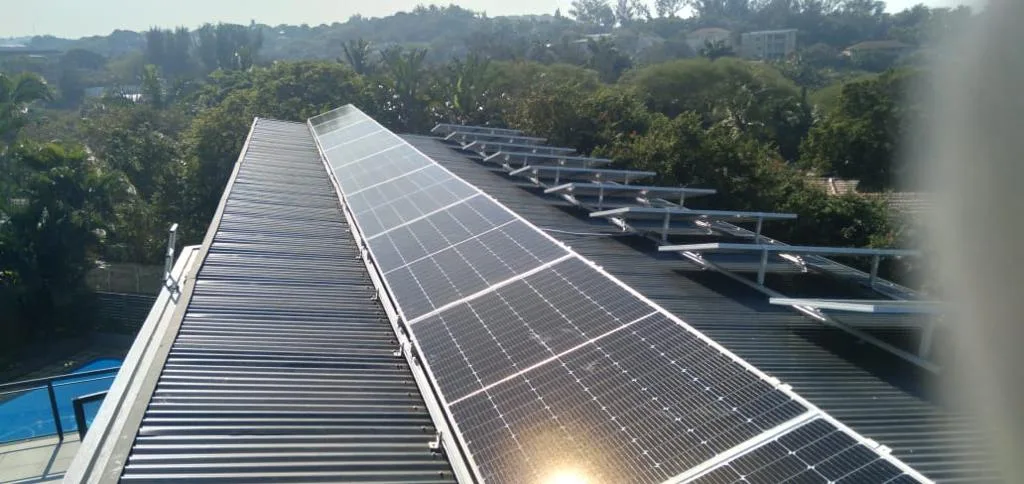
Make resilience part of the project brief
For a business, a damaged array can mean more than replacement panels. Access restrictions, lost generation, disruption to trading and the time needed to assess the rest of the installation all matter. Those consequences belong in the planning discussion, rather than being considered only after a storm.
Ask how the proposed equipment and installation address the actual site. Relevant history, nearby impact hazards, roof access and the organisation's tolerance for downtime are useful inputs. A generic claim that panels are 'hail resistant' does not answer those questions.
Ask what was tested, on which module
Hail qualification describes a controlled test under stated conditions. It is not a guarantee against every storm or other impact. Ask for the exact module model, the test method, the impact conditions and the results. Do not assume a report for a different product construction covers the panel in your proposal.
More demanding assessments exist. IEC TS 63397 addresses increased hail resistance beyond the IEC 61215 series, while Kiwa PVEL offers additional hail testing. Neither reference means that every model from a particular manufacturer has passed those tests. Obtain the evidence covering the offered module rather than relying on a brand name, a wattage figure or a demonstration video.
Keep the complete installation in view
Panel selection is only one part of a resilient project. The mounting design and installation must follow the applicable instructions for the exact equipment. Canadian Solar's manual, for example, specifies mounting arrangements rather than treating every clamp position as interchangeable.
Ask the project team how the array can be inspected and an affected section accessed without unnecessary disruption to the premises. Keep the agreed design, equipment schedule and relevant installation instructions with the handover information. These records make later assessment more useful; they do not make an installation storm-proof.
A normal-looking graph is not a safety clearance
Hail can damage cells even when the glass has not visibly shattered. Kiwa PVEL describes cracked cells as a possible route to later power loss. A monitoring record is useful evidence, but continued production does not establish that every module and connection is sound.
After a significant event, let the responsible professional determine the inspection and any specialist testing needed. Do not treat one obvious damaged panel as proof that the rest of the array is unaffected, or assume that all modules must be replaced without an assessment.
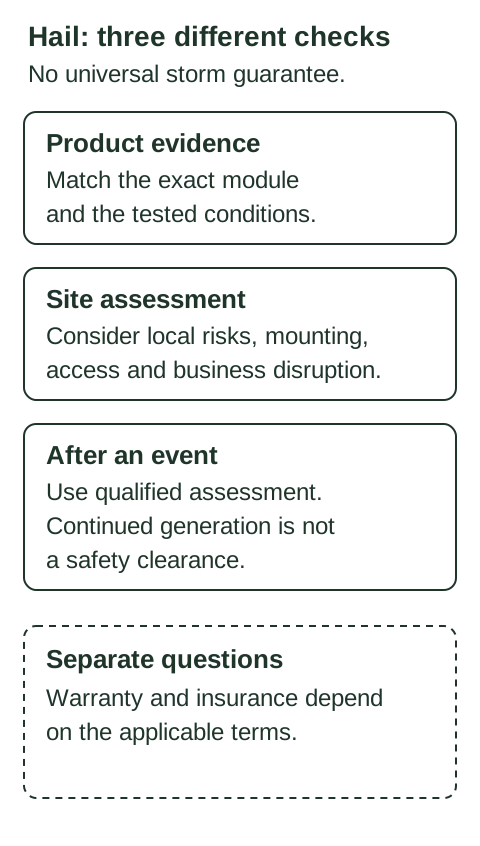
Read the text explanation and sources
- Product evidence should identify the exact module and tested conditions.
- Site assessment considers local risks, mounting, access and business disruption.
- After an event, use qualified assessment; continued generation does not establish safety.
- Warranty and insurance are separate questions governed by the applicable terms.
Sources supporting this illustration
Keep people away from damaged equipment
If damage is visible or suspected, keep people away from the affected equipment and arrange assessment by a qualified solar or electrical professional. Do not climb onto the array, touch cracked glass, disconnect connectors or try to patch a module.
Modules can generate electricity in daylight even when other equipment is off. Canadian Solar warns that broken modules can present an electric-shock hazard, particularly when wet, and says not to use broken modules or attempt to repair their parts. Leave decisions about isolation, safe access and replacement to the appropriate professional. For an immediate danger such as smoke or fire, keep clear and contact the appropriate emergency service.
Prepare a response file before you need it
Give one person responsibility for the records and the first call. Keep the inspection route separate from any decision about a warranty claim or insurance cover; neither should delay making a suspected hazard safe. Confirm cover and claims requirements directly with the relevant insurer or supplier rather than assuming what a policy includes.
- Site contact, responsible project or support contact, and a safe-access procedure.
- Module models, equipment schedule, installation documents and previous condition photographs.
- An incident log recording the date, affected areas, observed alarms and any loss of service.
- Photographs taken only from a safe, accessible position; no roof access merely to collect evidence.
- Available monitoring records, the professional assessment and a written recovery scope.
Use the risk discussion to improve the proposal
For a new commercial project, tell us about the site's resilience and access requirements. Share the location, the business activity, relevant incident history and any insurer requirements already provided to you. We confirm the appropriate equipment, assessment or referral route and service coverage for the particular site; no universal storm-damage repair or emergency response is promised.
Sources and further reading
- Kiwa PVEL: hail stress testing, glass breakage and cell damage
- IEC TS 63397:2022: qualifying guidelines for increased hail resistance
- Canadian Solar photovoltaic module installation manual, revision 3.1: safety and mounting instructions
- US Department of Energy: design and operations considerations for hail resilience
See the approach in practice
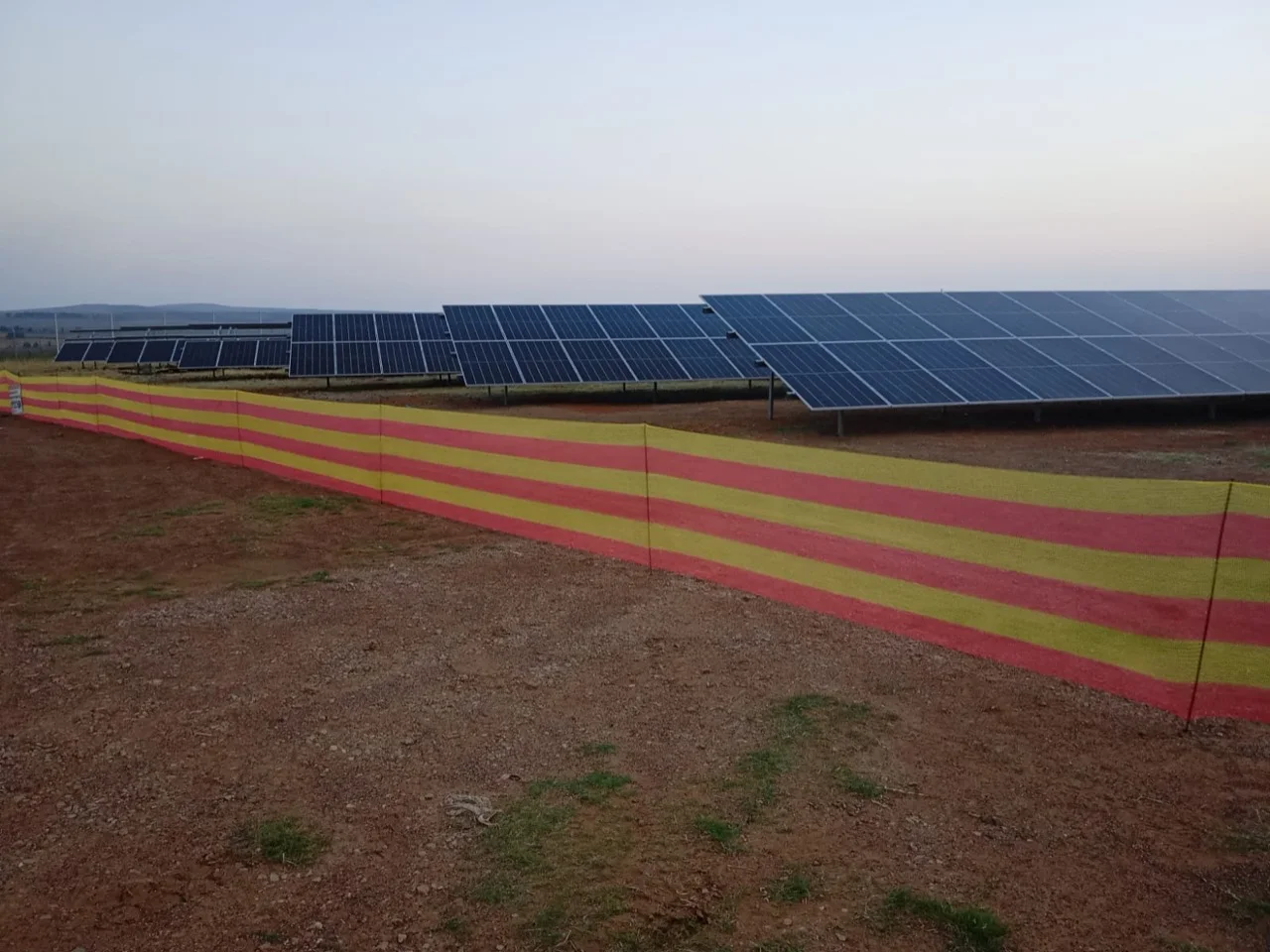
Site experience
Solar for demanding sites
Ground-mounted solar in an oil-and-gas environment.
See the installation