Start with a useful job, not another device
A business can have a productive solar array and still buy electricity for work that happens after sunset. Before adding equipment, ask whether some of that work could happen earlier. The opportunity is not to consume more electricity; it is to move a task you already need into a more useful part of the day.
Water heating, a suitable transfer pump or charging a vehicle that remains on site may offer flexibility. A refrigeration process, production deadline or safety-critical service may not. The person responsible for operations should help decide which jobs can move and which must remain independent of available sunshine.
Check whether the surplus is real and repeatable
A sunny-day screenshot is not an operating plan. Review generation, consumption, battery charging and grid exchange together over representative working days. Include quieter periods, cloudy days and seasonal changes.
In a system that cannot export, solar output may be limited when there is nowhere useful for the energy to go. That can explain a fall in production without proving a fault. It also does not tell you exactly how much extra energy a new load could use. Establish the available opportunity before attaching a savings figure to it.
Write a short operating brief for each candidate load
The equipment rating is only part of the brief. A task can be movable without being safely interruptible every time a cloud passes. Ask the equipment supplier about its permitted control method and operating limits.
- What useful work must be finished, and by what time?
- What are the running demand, starting behaviour and electrical supply requirements?
- Can the task pause, and what minimum run or rest periods does the equipment require?
- Does it have a supported control input, or would a correctly designed switching arrangement be needed?
- What must happen if there is insufficient solar: postpone the task, use another energy source or ask an operator to decide?
- Who can override the schedule, and who is responsible if the work is not completed?
Use the simplest control that meets the brief
A revised operating schedule may solve a straightforward timing problem. Where available solar changes substantially, coordinated control may be more suitable. Do not commission a custom automation project merely because a dashboard can display the data.
For example, Victron's GX Opportunity Loads can coordinate suitable AC loads on supported systems. Its current requirements include compatible inverter/charger and GX equipment, Venus OS 3.80 or later, the New UI, battery information and monitoring of all solar production. It is not a universal smart switch, does not control DC loads and does not establish compatibility with an arbitrary industrial machine.
Treat this as one possible design route, not a promise that an existing system supports it. Confirm the complete hardware, software and appliance-control arrangement before buying parts. Fixed-wiring changes belong with an appropriately qualified electrical professional.
Agree the priorities before switching anything automatically
Write down the order of importance: essential operations, battery charging or reserve, and the flexible task. A control label such as 'surplus only' is not, by itself, a guarantee that the battery will never supply energy. Victron specifically notes that brief battery use can occur when solar falls or a load must complete a minimum run period.
Commission the cloudy-day and outage behaviour as well as the sunny-day demonstration. Include a lost connection, an unavailable reading, a controller restart and manual override. The equipment's own protections must remain effective; an automation command is not proof that the physical machine started or stopped.
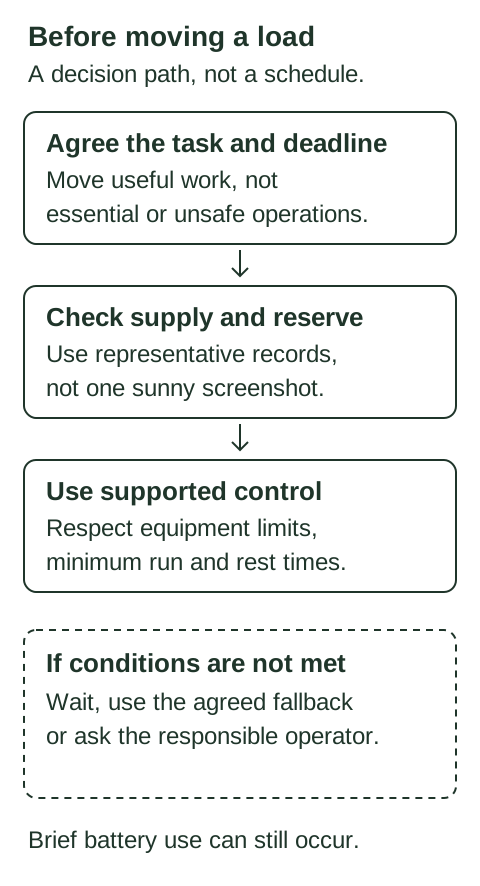
Read the text explanation and sources
- Agree which useful work can move and the deadline, without compromising essential or safe operation.
- Check supply and battery reserve using representative evidence rather than one sunny screenshot.
- Use supported control that respects equipment limits and minimum run and rest periods.
- If conditions are unsuitable, wait, use the agreed fallback or ask the responsible operator.
- Brief battery use remains possible; no clock times, generation profile or savings are assumed.
Sources supporting this illustration
Judge the result by completed work and measured energy
Record whether the required task was completed, when it ran and what energy it used. Compare grid purchases and operating conditions before and after the change. Label calculated consumption separately from readings taken by a meter.
More self-consumed solar is not automatically the same as a lower total bill. Check the applicable tariff and any export arrangement, and account for changed production, operating hours and consumption. Keep the initial forecast separate from the measured result.
Bring us the task and the constraints
For an initial discussion, share your business location, existing solar equipment, the load you want to move and its deadline. Include available monitoring records and the appliance model. We can assess whether a control or operating change is worth investigating, then confirm compatibility, service coverage and implementation scope.