Read the document that will apply to your installation
A battery advertised with a ten-year warranty does not necessarily provide ten years of identical cover for every component and application. Before accepting a proposal, obtain the applicable manufacturer warranty and the installer's separate workmanship and support terms.
Match the model, territory, installation size, intended use and document version. Keep that dated copy with the quotation and handover records. A residential document, a different country's terms or a later website revision does not establish the cover for your commercial project. Ask for written clarification where the scope is unclear.
Separate defects, capacity retention and design life
Product cover concerns specified defects. Performance cover concerns a defined remaining capacity under stated conditions. Design life describes an engineering expectation, not automatically a contractual remedy. Installation workmanship and an ongoing response service are separate again.
For a concrete scope example, BYD's published Premium LVS Commercial EN V1.1 document addresses qualifying non-European parallel systems of at least 50 kWh. It separates product cover from temperature-dependent performance periods. Its South African residential V1.1 document has a different size scope and performance structure. Neither should be silently substituted for the other, and neither establishes terms for every BYD product.
Ask which electronics, contactors, sensors and monitoring equipment share the cells' coverage. Hubble's published HV-Series 280Ah/314Ah document, for example, separates cell coverage from BMS and related sensor coverage. That is a reason to read component-level terms, not a brand ranking.
Understand what uses up a throughput allowance
Some performance warranties end at a calendar limit or an energy-throughput limit, whichever is reached first. Establish whether the counter measures charged energy, discharged energy or both, and whether it is measured at the battery or the AC connection. Those quantities are not interchangeable.
BYD's South African residential LVS V1.1 document, as one explicitly residential example, defines throughput using output energy recorded by the product's control module. Do not assume a different product uses that definition. Likewise, a BMS cycle counter may not count every partial charge as a complete cycle.
For an illustration unrelated to any named product, suppose a warranty allows 100 MWh of discharged energy. At an assumed 40 kWh discharged every day, that allowance represents 2,500 days, or roughly 6.8 years. This constant-duty arithmetic is not a lifespan forecast: the actual contract, operation and recorded energy determine the position.
Read the text explanation and sources
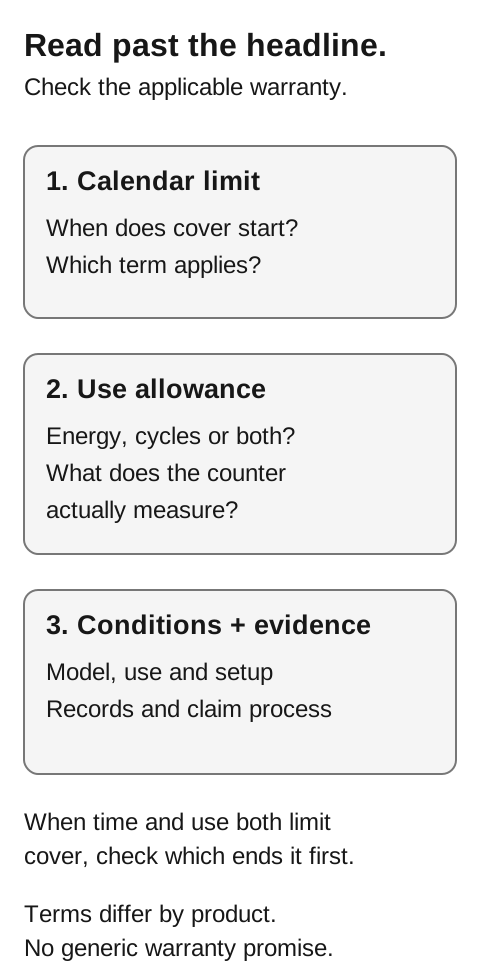
- Calendar: establish the applicable start date and term.
- Use: check any energy or cycle allowance and what its counter actually measures.
- Conditions and evidence: check the model, application, setup, operating requirements and claim records.
- When calendar and use both limit the relevant cover, check the first applicable limit. This is not a generic duration, retained-capacity guarantee or insurance policy.
Sources supporting this illustration
Ask how retained capacity is established
A capacity-retention threshold is meaningful only with its measurement method. Check the reference capacity, test temperature, current, charge preparation and stopping conditions. A dashboard's state-of-health estimate or a short outage is not automatically the manufacturer's required capacity test.
BYD's cited LVS documents specify a controlled test method rather than relying on the app percentage alone. Have the appropriate qualified party follow the applicable procedure; do not force a deep discharge or bypass protection to demonstrate a suspected fault. Keep estimated remaining capacity distinct from measured usable energy.
Make the operating conditions manageable
Review temperature conditions, compatible equipment, installation requirements, storage maintenance and any registration, internet or data-access obligations. Assign someone to complete required registration and retain confirmation. If connectivity is a condition, agree who notices a connection failure and restores it.
Hubble's cited HV-Series document includes registration and connectivity conditions as well as specific operating restrictions. They cannot be inferred from the headline warranty term. Manufacturers' ranges and documents also change; an older downloadable warranty is useful evidence for the relevant product, not proof that it governs a new purchase.
Understand the remedy and keep a practical evidence pack
Ask whether a valid claim leads to repair, replacement or a calculated refund, and whether replacement restarts the warranty. Clarify diagnosis, removal, transport, reinstallation, labour and downtime separately. Do not assume that a battery warranty pays every associated business cost. Ask the supplier to explain exclusions and any applicable statutory rights where needed.
- Keep invoices, delivery dates, serial numbers and the applicable warranty revision.
- Retain commissioning records, required registration, equipment configuration and compliance documents.
- Preserve dated faults, relevant monitoring exports and the original energy counters.
- Record the claim contact, notification deadlines and authorised service process.
Compare the whole proposal
Send us the proposed equipment, intended daily duty and the problem your business needs to solve. We can help frame the technical questions and identify missing evidence before a project proceeds. Specific cover must be confirmed against the actual offer, not this general guide.
Sources and further reading
- BYD Premium LVS Commercial EN V1.1: a scope-specific warranty example
- BYD Premium LVS Residential South Africa EN V1.1: residential throughput and test-method example
- Hubble HV-Series 280Ah/314Ah warranty: model-specific component and operating conditions
- Freedom Won official document library: current and end-of-life ranges distinguished