
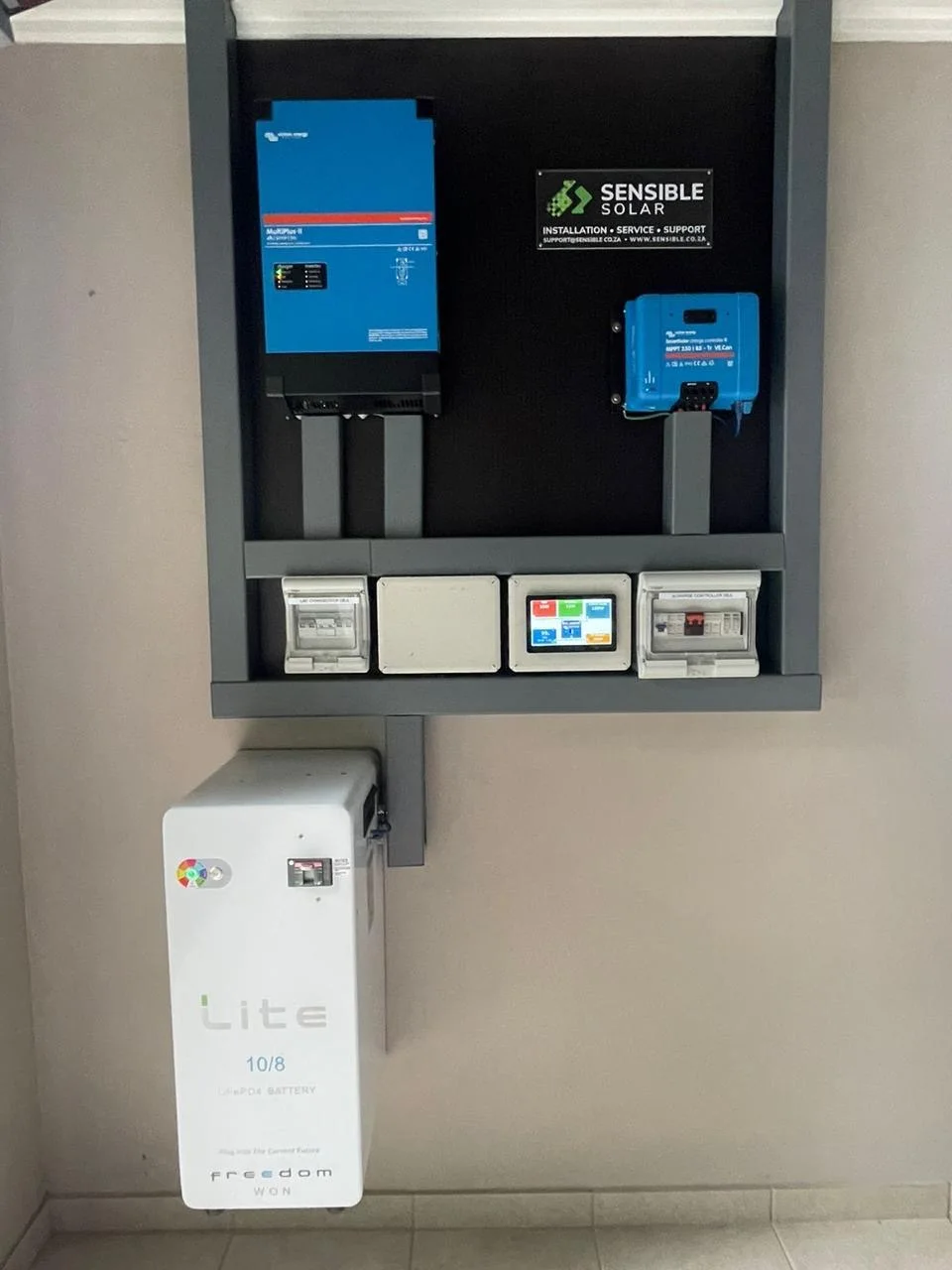
Start with the business requirement, not a package size
A battery proposal needs two answers: how much energy must be available, and how quickly the system must deliver it. A cold room, office and workshop may use similar daily energy while demanding very different instantaneous power. The consequences of stopping also differ.
Define the essential loads, acceptable interruption, required outage duration and expected daily cycling. Decide whether the same battery must support electricity-cost management and backup. Those jobs can compete for the same stored energy.
Keep energy, power and the measurement boundary separate
Energy capacity is expressed in kilowatt-hours, or kWh. Power is expressed in kilowatts, or kW. A large energy store does not automatically have enough continuous or starting power for the connected equipment. The inverter, battery current limits and electrical installation can each constrain the result.
Ask whether the quoted capacity is nominal battery energy, manufacturer-defined usable battery energy, or energy delivered to the AC loads. If the manufacturer has already excluded an internal reserve from its usable figure, do not subtract that same reserve again. A separately chosen operational backup reserve is another decision and should be shown explicitly.
Make a runtime estimate transparent
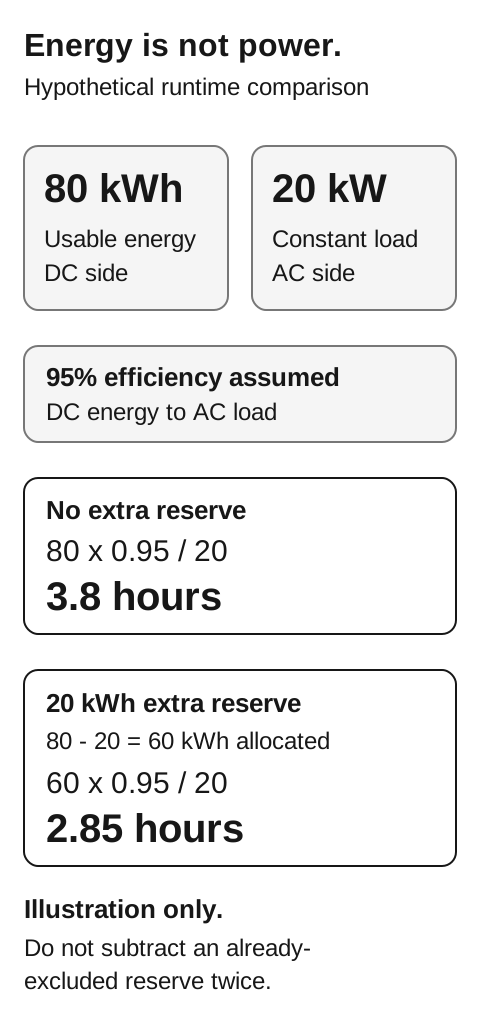
Consider a deliberately simplified illustration, not a product specification or site forecast. Assume 80 kWh of usable DC energy is available within the selected battery limits, a constant 20 kW AC load, and 95% discharge-path efficiency. The arithmetic is 80 multiplied by 0.95, divided by 20: approximately 3.8 hours.
If 20 kWh of that usable energy must remain untouched as an additional operational reserve, only 60 kWh is allocated to this task. Under the same assumptions, the illustration becomes approximately 2.85 hours. This is not an extra deduction for a manufacturer's already-excluded reserve.
Real runtime also depends on starting state of charge, changing loads, temperature, ageing, conversion losses and system consumption. A measured discharge test answers a different question from a calculation. Label each clearly, and explain where the energy and load were measured.
Read the text explanation and sources
- Energy capacity and output power are different quantities: the example uses 80 kWh on the DC side and a constant 20 kW load on the AC side.
- Assume 95% discharge-path efficiency: 80 x 0.95 / 20 = 3.8 hours.
- If a separate 20 kWh operational reserve is set aside, 80 - 20 = 60 kWh remains allocated: 60 x 0.95 / 20 = 2.85 hours.
- All quantities are deliberately hypothetical, not manufacturer ratings, measured results, ageing curves or a runtime promise.
Sources supporting this illustration
Check power at the battery, not only at the inverter
For a given DC power, lower battery voltage means higher current. An inverter's AC rating therefore cannot establish how many battery modules are needed. Check the exact battery's continuous and short-duration current capability, the permitted configuration and any manufacturer minimum module count.
C-rate expresses current relative to amp-hour capacity: 0.5C on a 100 Ah battery means 50 A. It is not a universal recommended setting. Establish whether a published figure is continuous, a brief peak, or conditional on temperature and state of charge. The proposal should also address motor starts and simultaneous loads rather than averaging them away.
Plan for ageing and the actual installation environment
Capacity can decline with time as well as cycling. Temperature, state of charge and duty cycle affect ageing; a cycle-life headline is not a prediction for every installation. A financial model should disclose its degradation assumptions and any replacement allowance instead of treating the first year's capacity as permanent.
Use the selected product's separate charging, discharging and storage limits. Also check derating and warranty conditions: permission to operate at a temperature is not proof of unchanged power, unchanged life or unchanged warranty cover there. Battery temperature and room temperature need not be identical.
For continuity-critical work, ask what remains available when a module, battery string or shared component is unavailable. Modularity alone is not redundancy. The remaining system must still meet the required power and energy, with a supported isolation and recovery arrangement.
Include the next recharge, not just the first outage
A bank that lasts through one interruption may be poorly prepared for the next. Review the available recharge window while the business continues operating. Solar conditions, grid supply limits, charger capability and battery charge limits all matter. Extra battery capacity does not create extra charging power.
Bring us your location, operating hours, recent bills, available interval data and a prioritised load list. For an existing installation, include equipment details and monitoring exports. We can establish the missing measurements before turning an illustrative calculation into a site-specific proposal.
Sources and further reading
- System Advisor Model: separate calendar and cycle degradation assumptions
- Victron and Pylontech integration: product-specific minimum battery sizing
- Victron Lithium Smart technical data: rated conditions and separate operating limits
- Victron Lithium Smart operation: a product-specific example of C-rate and charging requirements
- BYD Battery-Box official library: model-specific specifications and configurations