A certificate needs an understandable scope
Before accepting a solar installation or buying a property with one, ask what its electrical Certificate of Compliance, or CoC, actually covers. A certificate for new inverter wiring is not automatically evidence that every circuit in a house, factory or farm was inspected.
Read the certificate with its test report. These record inspection, testing and the identified installation or section. They are not a guarantee that equipment cannot fail, a promise of future safety or proof of solar production. For commercial premises, unclear boundaries can leave the owner, tenant and facilities manager with different assumptions about who has checked what.
Read the text explanation and sources
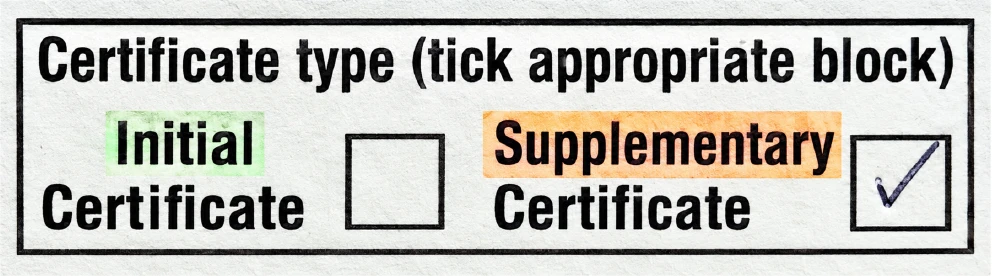
- The example shows the printed certificate-type options Initial Certificate and Supplementary Certificate.
- The Initial box is empty and the Supplementary box is ticked.
- The selection identifies the type of record in this illustration, not the scope or validity of a customer's installation.
Sources supporting this illustration
Keep the initial certificate and supplements together
The Department of Labour's explanatory notes distinguish an initial certificate from a supplementary certificate for later alterations or extensions. Large installations can have separate initial certificates for clearly identified sections, even from one point of control. Separate buildings do not, by themselves, establish those boundaries.
Check the certificate type, premises or section description, number, date, earlier-certificate reference and test report. A supplementary record should make the relationship understandable. Keep the documents together rather than filing only the newest solar certificate.
Under Regulation 7(4), adding to or altering an already certified installation requires certification covering at least that work. Agree how proposed solar, battery and distribution-board changes will be documented before work begins. A supplement does not retrospectively certify unrelated existing circuits.
Read the text explanation and sources
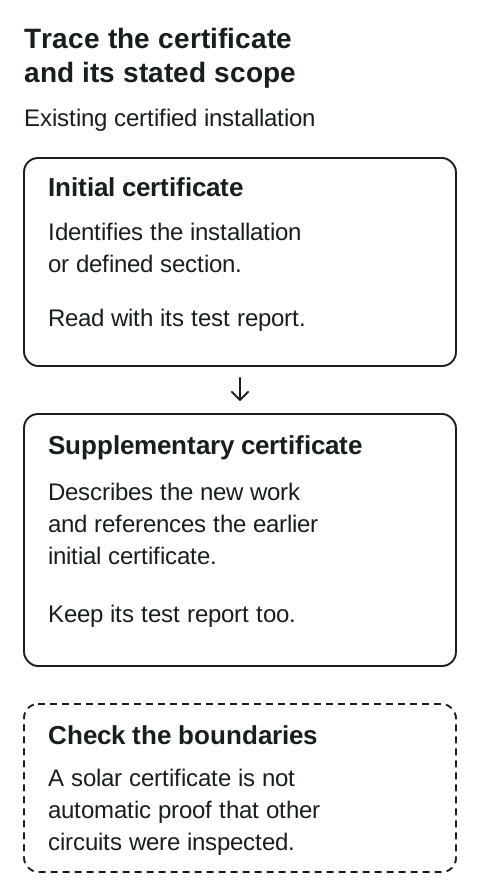
- Start with the initial certificate for the installation or defined section and its test report.
- For later new work, a supplementary certificate identifies that work and references the earlier initial record.
- Keep the related test reports together and check the stated boundaries.
- Do not assume the new solar document recertifies unrelated circuits. Confirm actual scope with the appropriate registered person.
Sources supporting this illustration
An existing-site problem needs an explicit plan
Responsibility for safe use and maintenance generally rests with the user or lessor, subject to the regulations' written lessee-transfer arrangement. Appointing a solar installer does not remove that responsibility. Certification requires the appropriate registered person and inspection and testing; an installer cannot promise a certificate regardless of what is found.
If records are missing, first ask the previous contractor, owner or managing agent whether they can be recovered. Missing paperwork does not prove that no certificate was issued. If the relevant scope remains unsupported, agree the inspection boundaries, findings, remedial-work quotation and certification route separately. Historical exemptions have conditions: additions or alterations to an installation qualifying under Regulation 7(3) trigger certification of the whole installation.
Two years is a transfer rule, not a universal expiry
The Electrical Installation Regulations do not impose a general two-year renewal cycle. That does not excuse later defects or undocumented alterations. For a change of ownership, Regulation 7(5) instead restricts using a certificate older than two years, expressly subject to section 10(4) of the Occupational Health and Safety Act.
Section 10(4) addresses a written undertaking to take specified steps sufficient to achieve the required compliance and safety. Do not treat it as an informal waiver: ask the conveyancer to assess its application and terms. Check certificate age at ownership change, alongside subsequent amendments to the installation and their certification scope. A recent solar supplement is not a shortcut to treating all older site certification as newly issued.
A CoC is not utility permission to connect
Electrical certification and electricity-distributor approval answer different questions. The relevant municipal or Eskom process must be established for the actual connection; a municipal street address does not necessarily mean the municipality supplies the site.
For example, eThekwini's published SSEG process includes a CoC, commissioning documents and written connection approval. Its requirements also distinguish capacity or configuration changes from other replacements. Do not assume an existing approval automatically covers a battery addition or larger inverter. Confirm current requirements with the relevant distributor before committing to equipment; a no-export intention is not, by itself, evidence of exemption.
Read the text explanation and sources
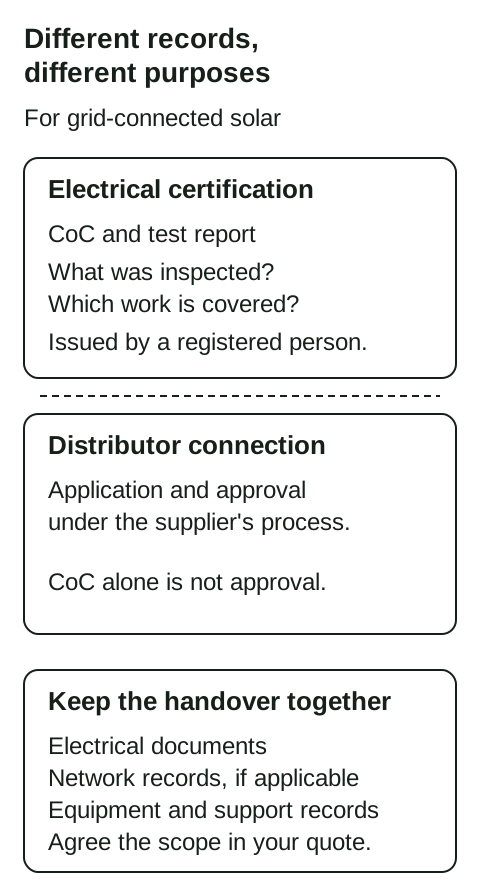
- The CoC and test report describe the electrical certification, inspected work and scope.
- The electricity distributor has a separate connection process; a CoC alone is not connection approval.
- Keep applicable electrical and network records with the equipment and support information agreed in the quotation.
- Actual requirements and responsible parties depend on the installation and electricity supplier.
Sources supporting this illustration
Agree the handover pack before installation
Ask who will supply each item and identify any exclusions in the quotation:
- Relevant initial and supplementary CoCs with their test reports.
- A clear description of certified boundaries and the work completed.
- Appropriate as-built diagrams, circuit identification and equipment records.
- Applicable distributor approvals and commissioning documents.
- Operating guidance, support contacts and outstanding actions.
Start with your existing records
Tell us the site location, electricity supplier, proposed change and which certificates or approvals you already have. We can discuss a suitable assessment and scope without promising certification in advance. Leave electrical inspection, testing and remedial work to appropriately registered professionals. This guide is general information, not site-specific electrical or legal advice.
Sources and further reading
- Electrical Installation Regulations, 2009: regulations 2, 7 and 9
- Department of Labour explanatory notes: initial and supplementary certificates, Gazette 35180
- Occupational Health and Safety Act 85 of 1993: section 10(4)
- eThekwini Municipality: SSEG requirements and application process
- Eskom: small-scale embedded generation requirements